
Eisenkot gets mandate to form government in Israel, Netanyahu struggles to maintain political existence
Jagrut Odisha Bureau, Israel ·
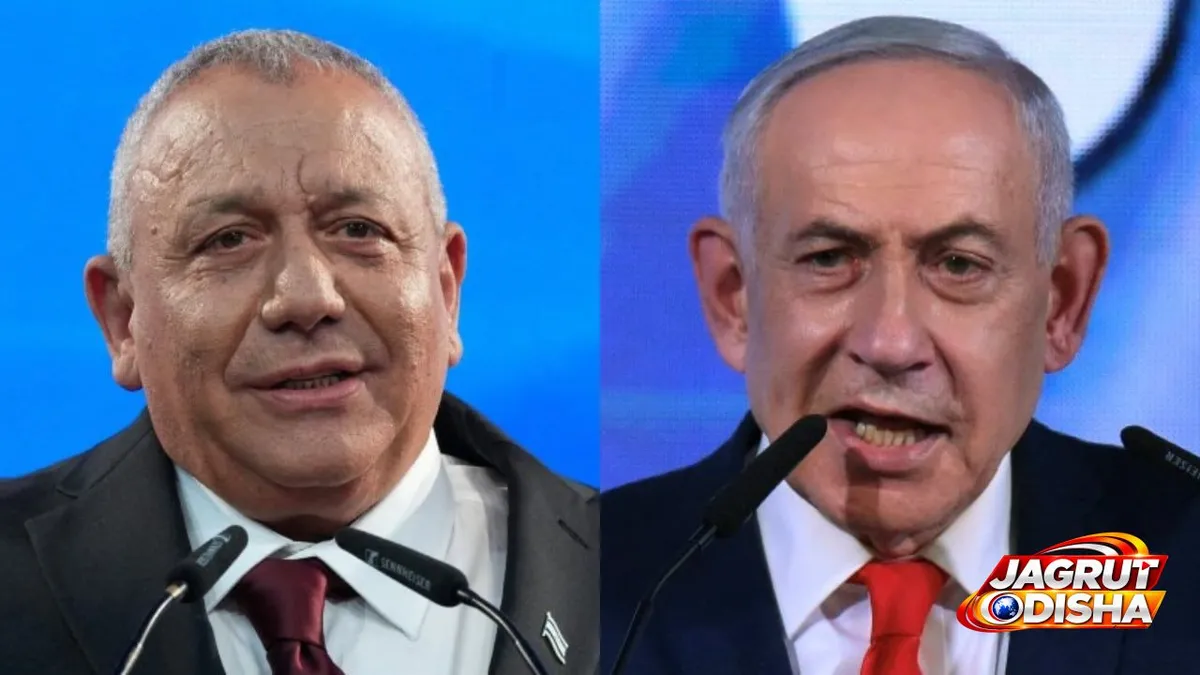
President Isaac Herzog has appointed former Israeli army chief and Yasser Party leader Gadi Eisenkot to form a new government in the country, a major blow to Benjamin Netanyahu, who is trying to maintain his grip on power.
Eisenkot is a former chief of staff of the Israel Defense Forces (IDF). He entered politics in 2022. He emerged as Netanyahu's main opponent in the election. He campaigned on parties ranging from the center-left to the right.
President Herzog made the decision after consultations with various parties in Israel's 120-seat parliament, the Knesset. The results of the October 27 election were divided, with no coalition able to reach a majority. Now, Eisenkot has his first chance to form a government. This could end Netanyahu's long-standing influence in Israeli politics.
Eisenkot will be formally handed over the responsibility of forming a government at a special ceremony at the Presidential Palace in Jerusalem on Sunday, November 8 at 5:00 PM local time. Before making this decision, Herzog also held talks with Netanyahu and Eisenkot. He informed them both of the intention to hand over the responsibility to Eisenkot.
Electoral figures
During the meeting with the president, 67 MPs supported Eisenkot, while 46 MPs supported Netanyahu. The other 7 did not recommend any leader's name.
Among the 67 members of parliament who supported Eisenkot were 48 from the Change Bloc, seven from the Arab party RAM and 12 from the Giant List. On the other hand, Netanyahu was supported by his right-wing and religious allies. Seven members of the United Torah Judaism (UTJ) abstained.
The results show that while Netanyahu remains an influential politician, Eisenkot has been supported by more MPs as his replacement. However, simply getting support and achieving the majority needed to run a government are two different things.
Who is this Eisenkot, and what will happen next?
Eisenkot is a former chief of staff of the Israel Defense Forces (IDF). After entering politics in 2022, he emerged as Netanyahu's main rival. His electoral coalition was formed by various parties, from the center-left to the right. The main reason for bringing these parties together was their opposition to Netanyahu.
Eisenkot's Yasser Party came in second place in the election, winning 21 seats, while the broader "Change Bloc" won 48 seats. The two Arab-led parties combined to win a record 19 seats and recommended Eisenkot's name to the president. Their support was crucial in the decision.
Now, Eisenkot's biggest challenge is forming the next government. Arab parties are eager to support an alternative government to Netanyahu without joining the government. However, some of Eisenkot's own factions are unhappy with relying on them.
Additionally, the role of ultra-Orthodox parties could be important. The UTZ party's failure to support Netanyahu has created an opportunity for Eisenkot. But this opportunity could be lost if disagreements arise over the issue of military conscription.
Eisenkot has three main options: he can form a minority government with the external support of Arab lawmakers, he can negotiate with ultra-Orthodox parties, or he can try to form a broad national unity government. Each option has its own problems.
Netanyahu will not give up easily
Netanyahu has not yet conceded defeat. As caretaker prime minister, he has continued to push for a national unity government. He has opposed any government that relies on the support of Arab-led parties. He has even accused these parties of supporting terrorism. This has become a major source of controversy in the post-election debate.
In response, Eisenkot's party criticized Netanyahu and opposed his portrayal of Arab lawmakers as a security threat, and called on Likud members to reconsider their alliance with right-wing hardliners.
Israel is deeply divided over the Gaza war, national security, the future of the military, and Netanyahu's leadership. Eisenkot briefly joined Netanyahu's wartime cabinet after the Hamas attack on October 7, 2023. He later returned to the opposition.
Since then, he has emerged as a fierce critic of Netanyahu's handling of the war. He has also made it clear that he will not join any government led by Netanyahu. His military experience and expertise in the security sector are the mainstay of his election campaign.
If he succeeds in forming a government, he will become Israel's first Mizrahi prime minister. The Mizrahi community has its ancestral roots in the Middle East and North Africa.
What happens if Eisenkot fails?
After formally taking over the responsibility of forming a government from President Herzog, Eisenkot will have 28 days to form a coalition. The president can extend the deadline by another 14 days if necessary.
If Eisenkot fails to form a government, the president could hand the task to another leader. Netanyahu could also get another chance if he gets the necessary support. If no leader succeeds in forming a government despite multiple attempts, then Israel could hold another election in early 2027.
For now, President Herzog's decision is seen as a major event in Israeli politics. Netanyahu's government, the longest-serving prime minister in Israeli history, is now in danger of falling from power after losing its majority.
On the other hand, the road ahead is not easy for Eisenkot either. Winning the support of 67 MPs was his first success. But turning this support into a stable government will be his biggest challenge.
The question now is not just whether Netanyahu can retain power; all eyes are on whether the political forces that have come together against him can form a united government in the coming days.